Campaign of 1812
Dead SoulsThe Campaign of 1812 enters Dead Souls chiefly through a story told by the Postmaster: it is the war in which Captain Kopeikin lost an arm and a leg, then returned unable to earn his living and sought government assistance. The campaign’s significance lies less in a narrated battle than in its aftermath. Military service has cost Kopeikin his ability to work, while the system meant to address his need offers no immediate resolution. The novel also sets its journeys and estate economies against roads, weather, and the recurring labor of the seasons, giving the remembered campaign a place in a wider account of Russian life.
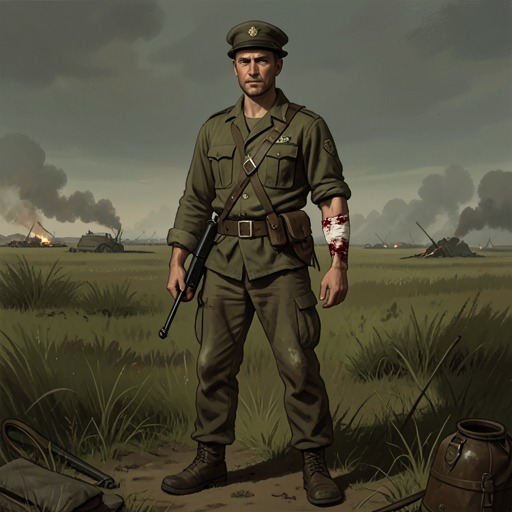
The campaign and its wounded veteran
The Postmaster introduces Kopeikin as a lively, headstrong veteran wounded during the campaign. He says that Kopeikin lost an arm and a leg at Krasni or Leipzig, leaving the precise battlefield uncertain. The story makes the consequence clear: Kopeikin cannot work with his remaining arm, and there is no provision for wounded soldiers. His father can barely support himself, so Kopeikin decides to travel to St. Petersburg and ask for help on the grounds that he has risked his life and shed blood for his country.
The account presents that appeal as a consequence of the war rather than an episode of combat. Kopeikin’s injuries shape the practical terms of his return: he arrives in the capital by baggage wagon, pays for a cheap lodging, and shaves himself with his left hand to avoid the expense of a barber. The details establish how little money he has and how closely his daily choices are constrained by the loss of his limbs.
Petition and bureaucratic delay
Kopeikin is advised that the Government is away in Paris and the troops have not yet returned, but that a Temporary Commission is sitting. He goes to seek its President, making his way to an imposing house on Naberezhnaia Street. After waiting four hours among a crowded reception, he explains that he has lost both an arm and a leg in service and cannot work, and asks for help, a gratuity, or a pension if the regulations allow it.
The President acknowledges Kopeikin’s condition but tells him to return in a few days. Kopeikin initially takes this as progress; the story’s available passage establishes a deferment, not a final decision on his petition. The contrast between his urgent material need and the formal, delayed response gives the campaign an institutional afterlife: sacrifice has occurred, but support remains uncertain.
Roads, weather, and the Russian landscape
Elsewhere, travel in the novel is repeatedly governed by physical conditions rather than by a perfectly controlled itinerary. During a storm, rain forces Chichikov to draw the curtains of his carriage and urge Selifan to hurry. Selifan, distracted and unsure how many turnings have passed, chooses a road without knowing where it leads. On another journey, the weather is fine but the ground is so sodden that mud cakes the carriage wheels, slows the vehicle, and makes the girl’s directions essential among roads that branch in every direction.
The road scenes widen into a catalogue of provincial travel: roadside inns, villages, road menders, repaired bridges, market booths, fields, and freshly tilled strips of earth. The narrator sets this open, level country against more dramatic landscapes, yet emphasizes the powerful attraction Russia holds despite its apparent lack of picturesque spectacle. The campaign is recalled within this same world of long distances, difficult passage, and ordinary material conditions.
Seasonal labor and the meaning of time
In a separate discussion of estate management, Kostanzhoglo describes the year as an unbroken cycle of preparation, cultivation, harvest, storage, and winter work. Before spring, the landowner watches for the season, prepares seed, calculates crops, and organizes workers. With the thaw come work in gardens and fields; summer brings reaping; after harvest, grain must be stored and buildings prepared for winter; during winter, grain is threshed, mills and factories inspected, and workers’ circumstances attended to.
This account connects time to labor and responsibility rather than to passive waiting. It also offers a contrast with the campaign’s aftermath: the veteran’s inability to work is a lasting consequence of service, while the landowner’s annual work is presented as a source of production and purpose. Together, the military recollection, the difficult roads, and the agricultural calendar show how the novel makes historical time tangible through the bodies, journeys, institutions, and work that continue after an event has passed.